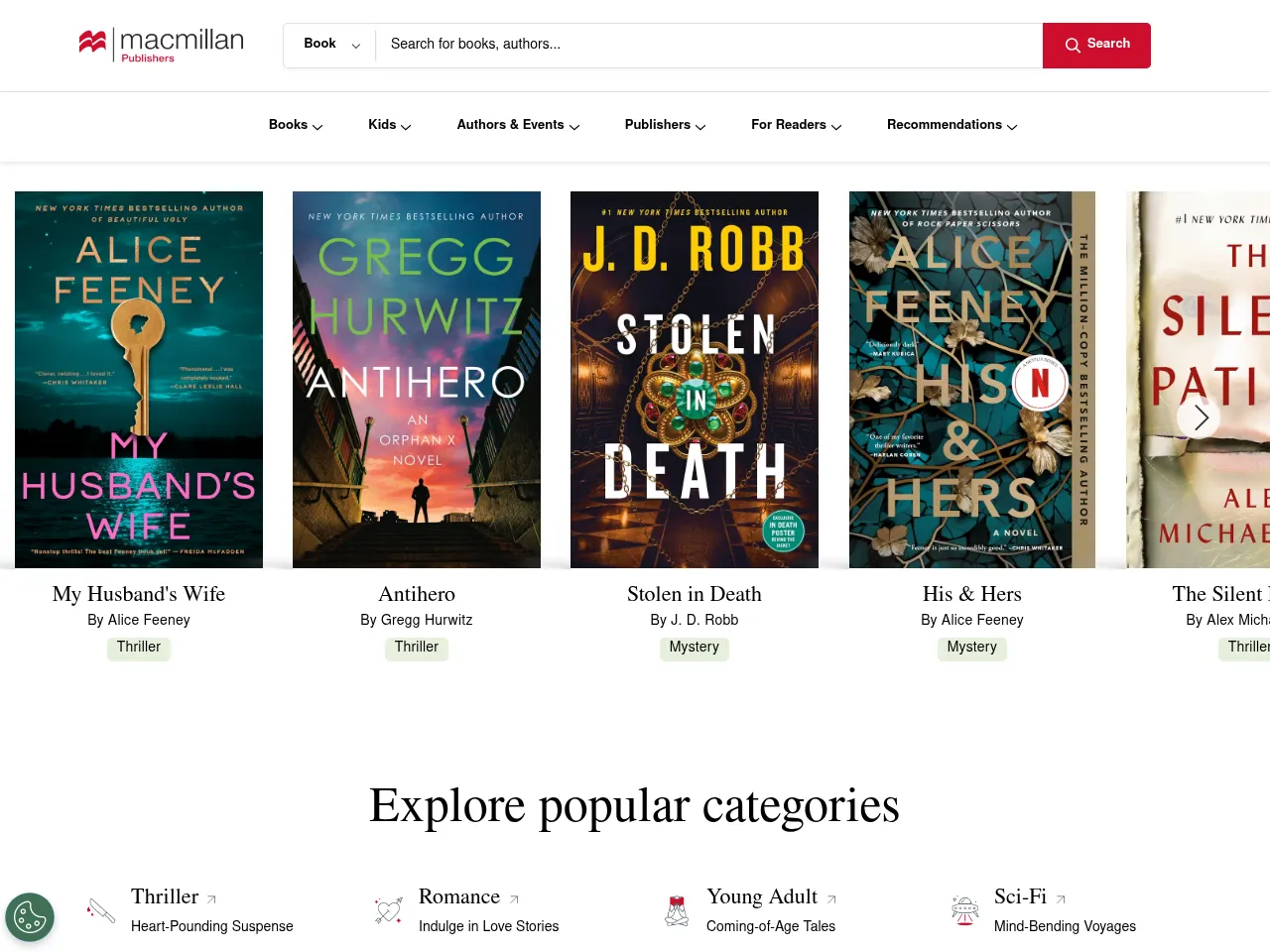
Macmillan Publishers is one of the five largest English-language publishers in the world, with a storied history stretching back to 1843 when brothers Daniel and Alexander Macmillan founded the company in London. Now a subsidiary of the German Holtzbrinck Publishing Group, Macmillan's US operations are headquartered in the iconic Flatiron Building in New York City. The company publishes under highly regarded imprints including Farrar, Straus and Giroux, Henry Holt, St. Martin's Press, Tor Books, Picador, and Celadon Books. Macmillan is known for a prestigious literary catalog that includes Nobel Prize laureates, National Book Award winners, and perennial bestsellers. Notable authors on its roster include Jeffrey Eugenides, Hilary Mantel, Lauren Groff, and Brandon Sanderson. Farrar, Straus and Giroux alone has published more Nobel Prize-winning authors than any other American publisher. St. Martin's Press ranks among the most commercially successful imprints in the industry. Tor Books is widely considered the premier publisher of science fiction and fantasy. Macmillan has been a forward-thinking presence in digital publishing, investing in innovative direct-to-consumer channels and audiobook expansion. The company also maintains a significant academic and educational publishing division through Macmillan Learning, serving higher education markets with textbooks and digital learning tools.
Book Publishers
Macmillan Publishers is a Big Five publisher known for its literary prestige, operating imprints including Farrar, Straus and Giroux, Henry Holt, St. Martin's Press, and Tor Books.
Brand Details
IndustryPublishing
Founded1843
HeadquartersNew York City, New York, USA
Parent CompanyHoltzbrinck Publishing Group
4.1
1 reviews
Content Quality
4.5
Catalog Breadth
4
Cultural Impact
4
Production Value
4
Accessibility
3.8
Claude Opus 4.6
AI Review
4.1/5
Macmillan occupies an enviable position in publishing, home to some of the most prestigious imprints in the English-speaking world. Farrar, Straus and Giroux's track record with Nobel laureates is genuinely unmatched among American publishers, and Tor Books has built a near-monopoly on reader loyalty in science fiction and fantasy. St. Martin's Press reliably delivers commercial hits. The breadth and quality of the literary catalog is the brand's strongest asset.
The educational division, Macmillan Learning, is competent but faces the same structural challenges as all traditional textbook publishers: declining print adoption, price resistance from students, and competition from open educational resources. The digital learning tools are adequate without being industry-leading.
As a subsidiary of Holtzbrinck, Macmillan has the financial backing to invest in talent acquisition and digital infrastructure, though it sometimes appears slower to adapt than more nimble competitors. The publisher's commitment to literary quality over pure commercial calculation is admirable and increasingly rare, even if it occasionally means leaving money on the table. A strong, credible name in publishing with room to sharpen its digital strategy.